
Build a weekly roofing cash flow review
Start with available cash, schedule expected receipts and payments, and check what happens when a large collection slips. The roofing cash flow forecasting guide includes a worked example and a weekly review checklist.
Use the mortgage hold and supplement tracking guides to understand why invoice age and actual payment timing can diverge.
Roofing cash does not arrive on one schedule
Insurance proceeds, mortgage endorsements, supplements, retainage, direct pay invoices, payroll, material bills, and subcontractors all move on different clocks. A strong sales backlog can still create a cash crunch when those clocks do not line up.
Forecast from the financial record
- Expected collections based on open invoices and payment behavior.
- Weekly cash movement rather than one monthly total.
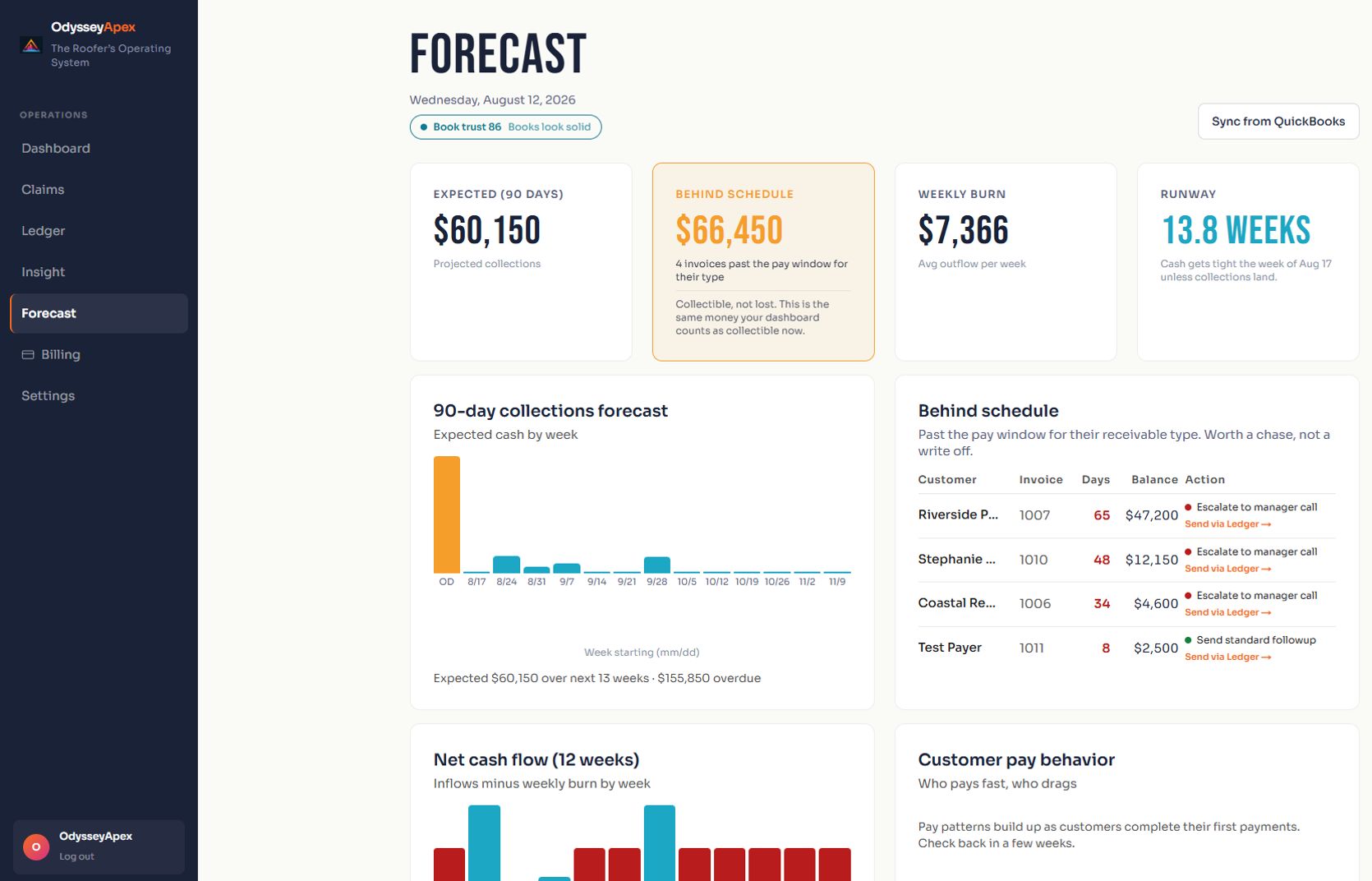
- Operating burn and the runway supported by current cash.
- Receivables that are falling behind their expected path.
- Weeks where expected collections and recorded operating costs create pressure.
Separate expected cash from possible acceleration
A forecast should not treat every open dollar as if it will arrive on time. Odyssey separates expected collections from money that may move sooner after a specific billing, documentation, or collection action.
When a tight week appears early, the owner can change the collection plan, purchasing schedule, production timing, or financing decision before the bank balance forces the move.
Keep the forecast connected to reality
The view updates as invoices, payments, and cash activity change in QuickBooks Online. Trust Score identifies weak source data so the forecast does not present false precision.
Roofing cash flow forecasting questions
What inputs does the forecast use?
It uses open accounts receivable, customer payment behavior, expected collection timing, current cash, operating costs, and recurring expenses recorded in QuickBooks Online.
What does the forecast show?
The ninety-day view shows expected collections, weekly cash movement, available runway, receivables moving behind their expected path, and weeks where cash pressure may rise.
Does it separately model payroll schedules or supplement approval dates?
Not currently as separate forecast events. The forecast reflects financial activity recorded in QuickBooks Online and should be read as decision support, not a guarantee of payment timing.
See the full money coming workflow, connect the forecast to roofing receivables, or review how roofing payment stages work.